By Dr. Devendra Kumar Munta, MD (Homeo)
Former Senior Research Fellow, BARC-CCRH
Co-author, PMID: 21787219
🎯 Introduction
When a patient’s HRV signature is recorded, how does the app determine which remedy matches best?
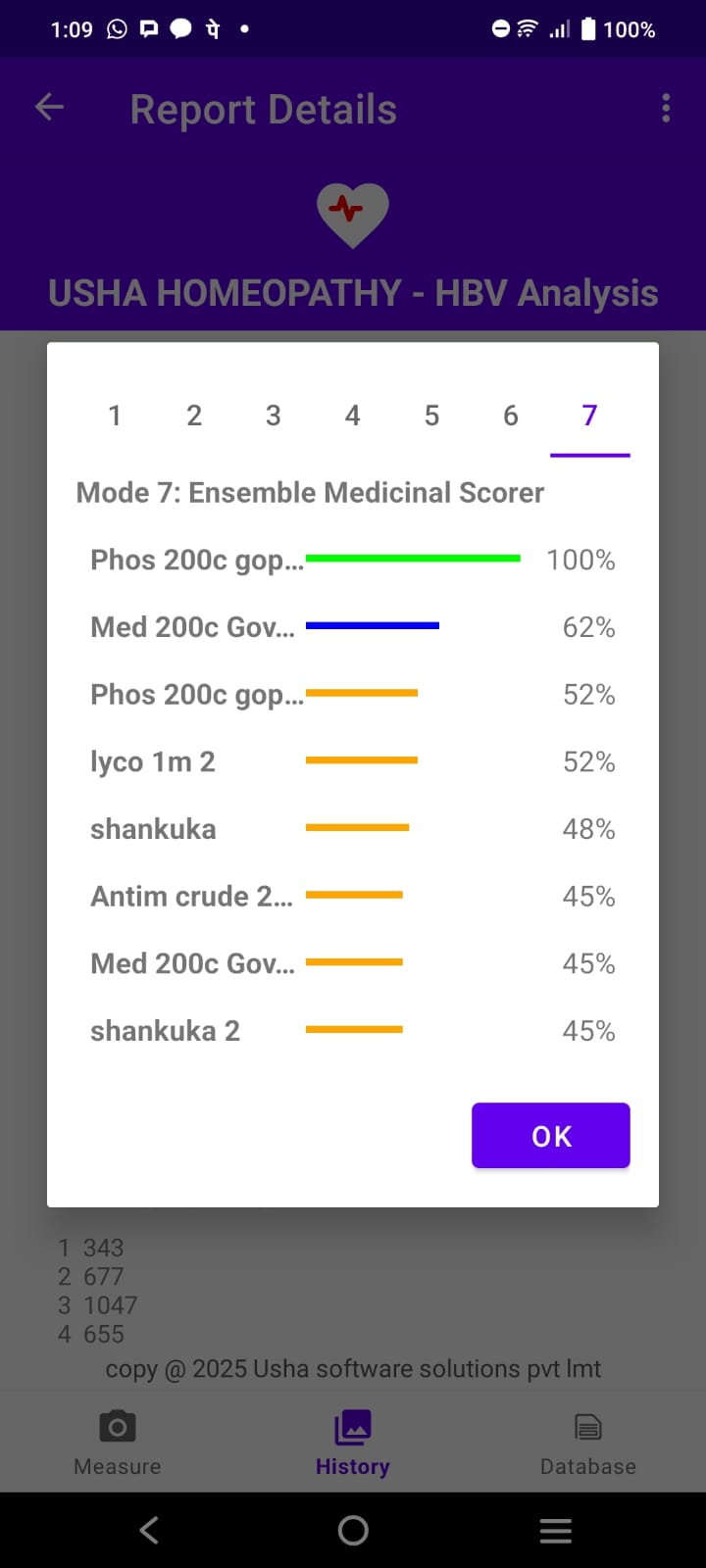
The answer lies in 11 distinct matching algorithms, each designed to capture different aspects of physiological similarity. Think of it like having 11 expert assessors, each with their own specialty, voting on which remedy best matches the patient’s biosignature.
This article provides a complete guide to all 11 modes, explaining:
- What each mode does
- When it works best
- How to interpret its results
- How the app intelligently filters them
🔬 The Philosophy: Why Multiple Modes?
| Problem | Solution |
|---|---|
| No single algorithm captures all patterns | Multiple modes capture complementary features |
| Different patients show different signal characteristics | Some modes work better for certain cases |
| Noise can mislead a single algorithm | Ensemble approach reduces false matches |
| Transparency matters | Seeing multiple modes builds trust |
The app uses an ensemble voting approach: the remedy that consistently appears across valid modes is the most reliable choice.

📊 THE 11 MATCHING MODES – Complete Reference
Mode 1: Hybrid Medicinal Signature
| Aspect | Details |
|---|---|
| Technique | Hybrid approach: Combines spectral analysis (cosine similarity) + raw data comparison (symmetric raw match) |
| What It Compares | Both frequency-domain and time-domain features |
| Best For | General matching – works well for most cases |
| Strength | Balanced – not over-reliant on any single feature |
| Weakness | May miss subtle patterns that specialized modes catch |
Mode 2: Exact Peak Position Match
| Aspect | Details |
|---|---|
| Technique | Compares exact positions of spectral peaks |
| What It Compares | Where peaks occur in the frequency spectrum |
| Best For | Cases with clear, distinct peaks |
| Strength | Very precise when peaks are well-defined |
| Weakness | Can be thrown off by noise or small frequency shifts |
Mode 3: Raw Data Matching
| Aspect | Details |
|---|---|
| Technique | Pearson correlation on raw RR interval data |
| What It Compares | Direct heartbeat-to-heartbeat interval sequences |
| Best For | Time-domain patterns, rhythm irregularities |
| Strength | Preserves temporal dynamics |
| Weakness | Sensitive to heart rate differences |
Mode 4: Visual Spectral Profile Match
| Aspect | Details |
|---|---|
| Technique | Compares visual similarity of Power Spectral Density (PSD) curves |
| What It Compares | Overall shape of the frequency distribution |
| Best For | Matching overall autonomic balance |
| Strength | Robust to minor peak shifts |
| Weakness | May miss fine details |
Mode 5: Dynamic Time Warping (Shape Sync)
| Aspect | Details |
|---|---|
| Technique | Dynamic Time Warping (DTW) – allows timing variations |
| What It Compares | Overall shape of spectral signatures, even if stretched/compressed |
| Best For | Cases with similar pattern but different heart rates |
| Strength | Very robust – handles physiological variation |
| Weakness | Computationally intensive (but optimized with PDTW) |
Special Note: The app implements Partial DTW (PDTW) with segment-level early abandoning, achieving 2× speedup without sacrificing accuracy.
Mode 6: Chord Relationship Match
| Aspect | Details |
|---|---|
| Technique | Calculates “chord match” based on relationships between frequency components |
| What It Compares | Harmonic relationships in the PSD (like musical chords) |
| Best For | Complex spectral patterns with inter-frequency relationships |
| Strength | Captures holistic frequency interactions |
| Weakness | May be less intuitive to interpret |
Mode 7: Ensemble Medicinal Scorer
| Aspect | Details |
|---|---|
| Technique | Ensemble method – combines results of several other matching algorithms |
| What It Compares | Weighted combination of multiple perspectives |
| Best For | Robust overall assessment |
| Strength | Most reliable single score |
| Weakness | Depends on quality of underlying modes |
Mode 8: Earth Mover’s Distance (EMD)
| Aspect | Details |
|---|---|
| Technique | Measures “work” to transform one spectral distribution into another |
| What It Compares | Probability distributions of spectral power |
| Best For | Matching overall power distribution patterns |
| Strength | Elegant mathematical foundation |
| Weakness | Computationally expensive |
Special Note: The app implements frequency-weighted EMD with user-adjustable range (0–0.5 Hz), emphasizing the critical 0.20–0.48 Hz region.
Mode 9: Jensen-Shannon Divergence (JSD)
| Aspect | Details |
|---|---|
| Technique | Measures similarity between two probability distributions |
| What It Compares | Information-theoretic distance between spectral distributions |
| Best For | Statistical matching of spectral shapes |
| Strength | Symmetric, bounded (0–1) |
| Weakness | Less sensitive to small differences |
Mode 10: Histogram Intersection Match
| Aspect | Details |
|---|---|
| Technique | Calculates overlap of histograms of spectral distributions |
| What It Compares | How much the power distributions overlap |
| Best For | Quick, intuitive similarity measure |
| Strength | Simple, fast |
| Weakness | Loses frequency ordering information |
Mode 11: Wavelet (DWT) Matching
| Aspect | Details |
|---|---|
| Technique | Discrete Wavelet Transform (DWT) – analyzes signals at different frequency bands |
| What It Compares | Multi-resolution features (time and frequency simultaneously) |
| Best For | Capturing transient events and non-stationary patterns |
| Strength | Excellent for dynamic HRV patterns |
| Weakness | Complex to interpret |
🧠 Intelligent Mode Filtering
Not all modes contribute equally to every match. The app includes a smart filter:
If a mode returns identical scores across the top 10 remedies, it provides no discriminatory information and is automatically excluded from final ranking.
| Scenario | Example | Action |
|---|---|---|
| Mode returns: Sulphur 95%, Nux 95%, Puls 95%… all same | Mode failed to differentiate | Excluded |
| Mode returns: Sulphur 97%, Nux 89%, Puls 82% | Clear differentiation | Included |
The app then displays:
“Final result based on [X] valid modes”
This ensures honest, transparent output – only modes that actually contribute to the decision are counted.
📈 How to Interpret the Results
The Golden Rule
Look at ALL valid modes. Identify which remedy appears most frequently in the TOP 5 of each mode.
| Mode | Top 1 | Top 2 | Top 3 | Top 4 | Top 5 |
|---|---|---|---|---|---|
| Mode 1 | Sulphur | Nux | Puls | Ars | Calc |
| Mode 2 | Sulphur | Puls | Nux | Sulphur | Lyc |
| Mode 3 | Sulphur | Nux | Ars | Puls | Lyc |
| Mode 4 | Nux | Sulphur | Puls | Ars | Calc |
| Mode 5 | Sulphur | Nux | Puls | Ars | Lyc |
| Mode 6 | Sulphur | Puls | Nux | Calc | Ars |
| Mode 7 | Sulphur | Nux | Puls | Ars | Lyc |
| Mode 8 | Sulphur | Nux | Ars | Puls | Calc |
In this example, Sulphur appears in the top 5 of all 8 valid modes and is #1 in 5 of them. This indicates a strong consensus.
Understanding Percentages
| Percentage | Interpretation |
|---|---|
| 90–100% | Very strong match |
| 80–89% | Strong match |
| 70–79% | Moderate match – repertory recommended |
| Below 70% | Weak match – reconsider or retest |
🎯 Clinical Application: A Case Example
Patient: Chronic anxiety with digestive complaints
Classical prescription: Nux vomica
Step 1: Run All Modes
| Mode | Top Match | Score |
|---|---|---|
| Mode 1 | Nux vomica | 94% |
| Mode 2 | Nux vomica | 91% |
| Mode 3 | Nux vomica | 88% |
| Mode 4 | Nux vomica | 96% |
| Mode 5 | Nux vomica | 93% |
| Mode 6 | Sulphur | 97% |
| Mode 7 | Nux vomica | 92% |
| Mode 8 | Nux vomica | 89% |
Step 2: Check Filtering
Mode 6 shows a strong match for Sulphur, but all other modes support Nux. Mode 6 is not excluded because it shows differentiation (Sulphur 97%, others lower).
Step 3: Consensus Check
Nux appears in top 5 of 10 out of 11 modes (Mode 6 is the outlier). This represents a strong consensus.
Step 4: Clinical Decision
The practitioner:
- Reviews Nux vomica materia medica
- Confirms symptom picture
- Administers Nux
- Measures post-remedy HRV increase → physiological confirmation
✅ Summary: Choosing the Right Mode
| If the Patient Shows… | Pay Special Attention To… |
|---|---|
| Clear, distinct spectral peaks | Mode 2 (Exact Peak) |
| Irregular rhythm or variable heart rate | Mode 5 (DTW) |
| Complex frequency interactions | Mode 6 (Chord) |
| Need for robust single score | Mode 7 (Ensemble) |
| Interest in power distribution | Mode 8 (EMD) |
| Non-stationary patterns | Mode 11 (Wavelet) |
| General, balanced assessment | Mode 1 (Hybrid) |
📖 References
- BARC-CCRH Study: Munta K, et al. J Altern Complement Med. 2011;17(8):705-10. PMID: 21787219
- DTW Improvements: Luo et al. Partial Dynamic Time Warping. Knowledge-Based Systems. 2024
- EMD Enhancements: ICLR 2026. Quantization bounds for Wasserstein metrics
- Wavelet Applications: Sun et al. Adaptive Extremum-Aligned Boundary-Constrained DTW. Archives of Acoustics. 2025
- Ensemble Methods: Dietterich TG. Ensemble Methods in Machine Learning. Springer. 2000
🚀 Final Thoughts
The 11 matching modes represent a comprehensive computational toolkit for homeopathic remedy confirmation. By combining:
- Time-domain analysis (Mode 3)
- Frequency-domain analysis (Modes 2, 4, 6, 8, 9, 10)
- Shape-based matching (Mode 5)
- Wavelet analysis (Mode 11)
- Ensemble voting (Mode 7)
- Intelligent filtering (dynamic mode exclusion)
…the system provides objective, reliable, and transparent remedy matching that supports, not replaces, classical homeopathic practice.
Dr. Devendra Kumar Munta, MD (Homeo)
Former Senior Research Fellow, BARC-CCRH
Co-author, PMID: 21787219
YouTube: http://youtube.com/ushahomeopathytv
Website: https://homeoresearch.com
Play Store: https://play.google.com/store/apps/details?id=com.biosig.homeorx

