By Dr. Devendra Kumar Munta, MD (Homeo)
Former Senior Research Fellow, BARC-CCRH
Co-author, PMID: 21787219
📖 Introduction
As homoeopaths, we often speak about the “vital force” – that dynamic, invisible energy that maintains health and responds to our carefully selected remedies. But what if we could see this response? What if we could measure, in real-time, how the body’s regulatory systems react to a homoeopathic medicine?
This is where Heart Rate Variability (HRV) enters our practice.
HRV is one of the most powerful, non-invasive tools available today for understanding the state of the autonomic nervous system – the system that controls everything we don’t consciously manage: heartbeat, breathing, digestion, and yes, the vital force itself.
🔬 What is Heart Rate Variability?
Heart Rate Variability is the variation in time intervals between consecutive heartbeats.
Let that sink in.
If your heart beats at exactly 60 beats per minute, that means one beat every 1,000 milliseconds – perfectly regular. But a healthy heart is not a metronome. It constantly adjusts: speeding up slightly when you inhale, slowing down when you exhale, responding to thoughts, emotions, and internal needs.
This variation is HRV.
| Heart Rate | HRV | Meaning |
|---|---|---|
| 60 BPM with 10ms variation | Low HRV | Rigid, stressed, less adaptable |
| 60 BPM with 50ms variation | High HRV | Flexible, relaxed, healthy |
Paradox: A healthy heart shows more variability, not less.
🧠 The Autonomic Nervous System Explained
To understand HRV, we must understand the two branches of the autonomic nervous system:
Sympathetic Nervous System (SNS) – “Fight or Flight”
- Prepares body for action
- Increases heart rate
- Reduces HRV
- Dominant during stress, danger, exertion
Parasympathetic Nervous System (PNS) – “Rest and Digest”
- Calms the body
- Slows heart rate
- Increases HRV
- Dominant during relaxation, sleep, recovery
HRV is the balance between these two systems.
| State | SNS Activity | PNS Activity | HRV |
|---|---|---|---|
| Acute stress | High | Low | Very Low |
| Chronic stress | High | Suppressed | Low |
| Healthy relaxation | Balanced | Active | High |
| Deep sleep | Low | High | Very High |
📊 How HRV is Measured
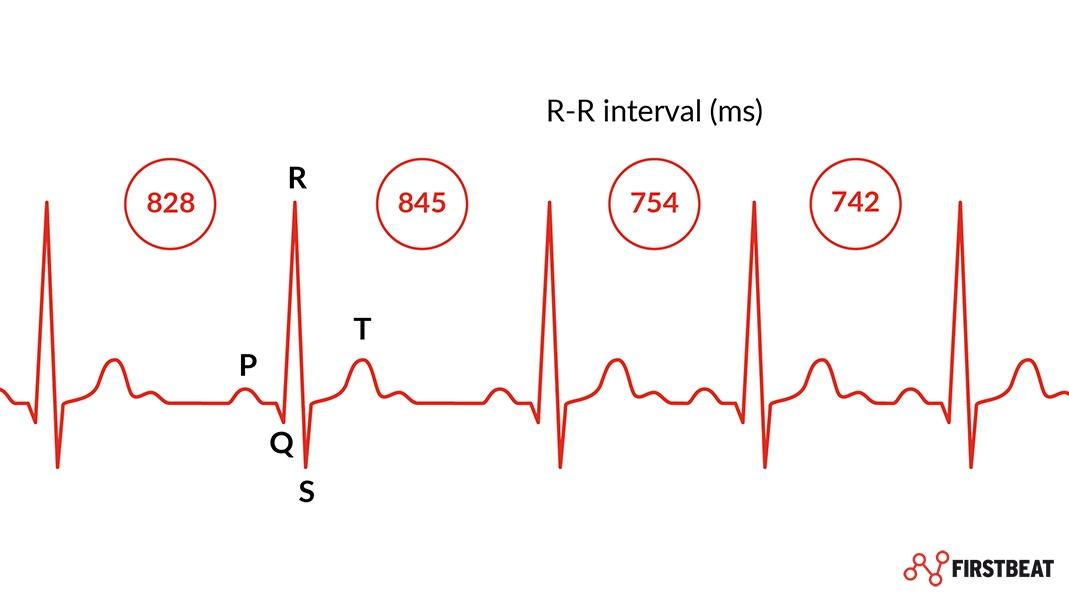
The R-R Interval
Each heartbeat produces an electrical impulse (the R wave on ECG). The time between two consecutive R waves is called the R-R interval.
Heartbeat 1: 0 ms
Heartbeat 2: 840 ms later (R-R interval = 840 ms)
Heartbeat 3: 820 ms later (R-R interval = 820 ms)
Heartbeat 4: 860 ms later (R-R interval = 860 ms)
These tiny differences – 20ms here, 40ms there – are the raw data of HRV.
Key HRV Metrics
| Metric | Full Form | What It Measures | Clinical Meaning |
|---|---|---|---|
| RMSSD | Root Mean Square of Successive Differences | Short-term variability | Parasympathetic activity (relaxation) |
| SDNN | Standard Deviation of NN Intervals | Overall variability | General autonomic health |
| LF/HF Ratio | Low Frequency / High Frequency | Sympathetic/Parasympathetic balance | Stress vs relaxation balance |
In our Biosignal-HomeoRx app, we primarily use RMSSD as it is most sensitive to parasympathetic (rest-and-digest) activity – exactly what we expect to see when the correct homoeopathic remedy acts.
💊 Why HRV Matters in Homoeopathy
The Connection to Vital Force
Dr. Hahnemann spoke of the vital force as an invisible, spirit-like power that animates the body. Modern physiology calls this the autonomic nervous system – the master regulator that operates below consciousness.
When the vital force is disturbed, disease appears. When the correct homoeopathic remedy is administered, the vital force responds.
HRV gives us a window into this response.
What Our Research Shows
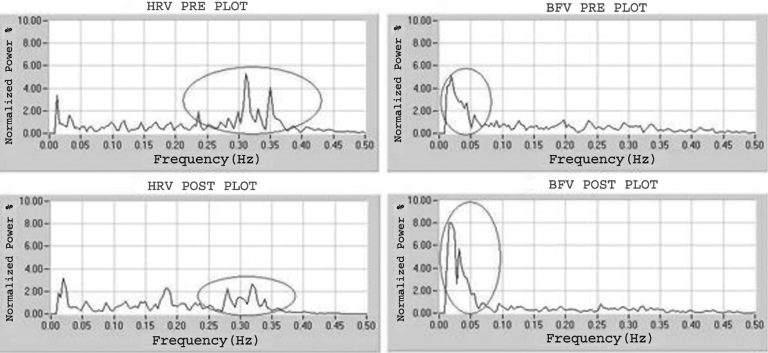
The BARC-CCRH study (PMID: 21787219) demonstrated:
| Substance | HRV Response Rate |
|---|---|
| Correct homoeopathic remedy | 62.5% |
| Placebo | 16.6% |
This means:
- When the right remedy is given, the autonomic nervous system shows a measurable, objective change in over 6 out of 10 cases
- Placebo produces change in only about 1.5 out of 10 cases
- The difference is statistically significant – not by chance
What HRV Tells Us About a Remedy
| Observation | Interpretation |
|---|---|
| HRV increases after remedy | Parasympathetic activation – body moving toward rest-and-digest (healing mode) |
| HRV decreases after remedy | Possible stress reaction or wrong remedy |
| No change | Remedy may not be acting, or patient is a non-responder in this session |
📱 How We Measure HRV in Biosignal-HomeoRx
Unlike conventional HRV devices that require ECG electrodes, our app uses two smartphone sensors:
Accelerometer
- Measures linear vibrations of the chest wall
- Captures valve closures and blood ejection
- Good for general HRV accuracy
Gyroscope
- Measures angular rotation of the sternum
- Captures the heart’s twisting motion during contraction
- More robust in lying-down position
- Contains up to 60% of cardiac vibrational energy
Sensor Fusion: By combining both, we get the best of both worlds – accuracy and robustness.
Validation (2023-2025 Studies)
| Metric | Performance |
|---|---|
| Beat-to-beat accuracy | ±5.22ms vs ECG |
| Correlation | R² > 0.999 |
| Sensitivity | 97.3% |
| Precision | 97.9% |
Smartphone sensors have now reached medical-grade accuracy.
🏥 Clinical Application: Before and After Remedy
The Protocol
| Step | Action | Duration |
|---|---|---|
| 1 | Patient lies down, stable mind | 2-3 minutes rest |
| 2 | Pre-remedy measurement | 3 minutes |
| 3 | Administer selected homoeopathic remedy | – |
| 4 | Wait for physiological response | 15-30 minutes |
| 5 | Post-remedy measurement | 3 minutes |
| 6 | Compare HRV values | – |
What to Look For
| Finding | Clinical Implication |
|---|---|
| HRV increases (RMSSD up) | Parasympathetic activation – remedy likely correct |
| HRV decreases (RMSSD down) | Possible aggravation or wrong remedy |
| HRV unchanged | No detectable autonomic response |
| Pattern matches known remedy signature | Confirms similarity (using database match) |
🌟 Case Example
Patient: Chronic anxiety with digestive issues
Remedy selected classically: Arsenicum album 200c
| Measurement | HR (BPM) | HRV (RMSSD) | Interpretation |
|---|---|---|---|
| Pre-remedy | 78 | 24 ms | Moderate stress, low variability |
| Post-remedy (20 min) | 72 | 38 ms | HRV increased 58% – parasympathetic activation |
The patient reported feeling calmer within hours. Over weeks, symptoms improved significantly.
The HRV change objectively confirmed what the patient felt subjectively.
⚠️ Important Considerations
Factors Affecting HRV
| Factor | Effect on HRV |
|---|---|
| Age | HRV naturally decreases with age |
| Time of day | Lowest on waking, varies diurnally |
| Recent exercise | Temporarily lowers HRV |
| Meals | Digestion affects autonomic balance |
| Mental state | Anxiety lowers, calm raises HRV |
| Medications | Many affect autonomic function |
This is why we use controlled pre-post protocol – each patient serves as their own control.
HRV is Not a Diagnosis
HRV tells us about the state of the autonomic nervous system, not the disease name. It is:
✅ A measure of physiological response
✅ A window into vital force activity
✅ A confirmation tool for remedy action
❌ NOT a diagnostic tool for specific diseases
❌ NOT a replacement for classical case-taking
🔗 Integrating HRV with Classical Homoeopathy
The app works best when combined with:
| Classical Tool | Role |
|---|---|
| Materia Medica knowledge | Understanding remedy pictures |
| Repertorization | Narrowing remedy choices |
| Case-taking | Capturing totality of symptoms |
| HRV analysis | Confirming the physiological response |
If you have sound homeopathic materia medica knowledge, it will be easier for you to decide the remedy. The app confirms physiologically what your knowledge suggests. Together, materia medica + biosignal analysis = confident prescribing.
📚 Summary
| Key Point | Takeaway |
|---|---|
| HRV is beat-to-beat variation | Healthy hearts vary; rigid hearts are stressed |
| Reflects autonomic balance | SNS (stress) vs PNS (relaxation) |
| Measurable via smartphone | ±5.22ms accuracy validated |
| Changes after correct remedy | 62.5% response vs 16.6% placebo |
| Clinical use | Pre-post comparison confirms remedy action |
| Not a replacement | Adjunct to classical homoeopathy |
🔬 Conclusion
Heart Rate Variability is not just a number – it is a window into the vital force. For the first time in homoeopathic history, we have a tool that can objectively measure the body’s response to our remedies.
The BARC-CCRH research proved that homoeopathic medicines produce real, measurable physiological changes. The Biosignal-HomeoRx app puts that power in your pocket.
When you combine:
- Your clinical wisdom +
- Your materia medica knowledge +
- Objective HRV confirmation
…you practice with a new level of confidence and precision.
📖 References
- Munta K, et al. An exploratory study on scientific investigations in homeopathy using medical analyzer. J Altern Complement Med. 2011;17(8):705-10. PMID: 21787219
- Parlato S, et al. Sensors 2023;23(13):6200 – Smartphone gyroscope validation
- Romano C, et al. Biosensors 2022;12(10):834 – Accelerometer vs gyroscope comparison
- Task Force of ESC/ASPE. Heart Rate Variability: Standards of Measurement. Eur Heart J. 1996;17:354-381
Dr. Devendra Kumar Munta, MD (Homeo)
Former Senior Research Fellow, BARC-CCRH
Co-author, PMID: 21787219
YouTube: http://youtube.com/ushahomeopathytv
Website: https://homeoresearch.com
The BARC-CCRH Study (PMID:21787219) – Full Explanation
By Dr. Devendra Kumar Munta, MD (Homeo)Former Senior Research Fellow, BARC-CCRH Collaborative ProjectCo-author, PMID: 21787219…

📱 Exclusive Early Access: Biosignal-Based Homeopathic Remedy Selection App
📱 Exclusive Early Access: Biosignal-Based Homeopathic Remedy Selection App Thank you for an incredible response!Our…
HRV Monitoring Using Smartphone Sensors: Facts vs. Myths
📱 HRV Monitoring Using Smartphone Sensors: Facts vs. Myths A Scientific Response to Common Questions…

Top 10 Homeopathic Remedies for Lifestyle Disorders
Top 10 Homeopathic Remedies for Lifestyle Disorders Lifestyle disorders such as diabetes, hypertension, obesity, cardiovascular…

Lifestyle Diseases and How to Overcome Them with Healthy Practices
Understanding Lifestyle Diseases: Causes, Symptoms, and Prevention In today’s fast-paced world, lifestyle diseases have become…

Understanding Homeopathic Biochemic Salts: A Gentle Approach to Healing
Understanding Homeopathic Biochemic Salts: A Gentle Approach to Healing Homeopathic biochemic salts, often referred to…
