📱 HRV Monitoring Using Smartphone Sensors: Facts vs. Myths
A Scientific Response to Common Questions

By Dr. Devendra Kumar Munta
Former Senior Research Fellow, BARC-CCRH Collaborative Project
Co-author, PMID: 21787219
❓ Q1: Is Heart Rate Variability from a smartphone accurate enough for clinical use?
✅ Answer: Yes – modern smartphone sensors match medical-grade accuracy.
Recent 2023–2025 validation studies demonstrate:
| Metric | Smartphone Performance (vs. ECG) |
|---|---|
| Beat-to-beat interval accuracy | ±5.22 milliseconds (Bland-Altman Limits) |
| Correlation with ECG | R² > 0.999 |
| Heart rate detection sensitivity | 97.3% |
| Heart rate detection precision | 97.9% |
| Breathing rate error margin | ±0.56 seconds |
| Overall HR error | 2.33% |
Source: MDPI Sensors Journal (2025); Directory of Open Access Journals (2023)
The gyroscope (which measures rotation) consistently outperforms accelerometers for cardiac mechanics, as it distinguishes heart motion from gravitational noise.
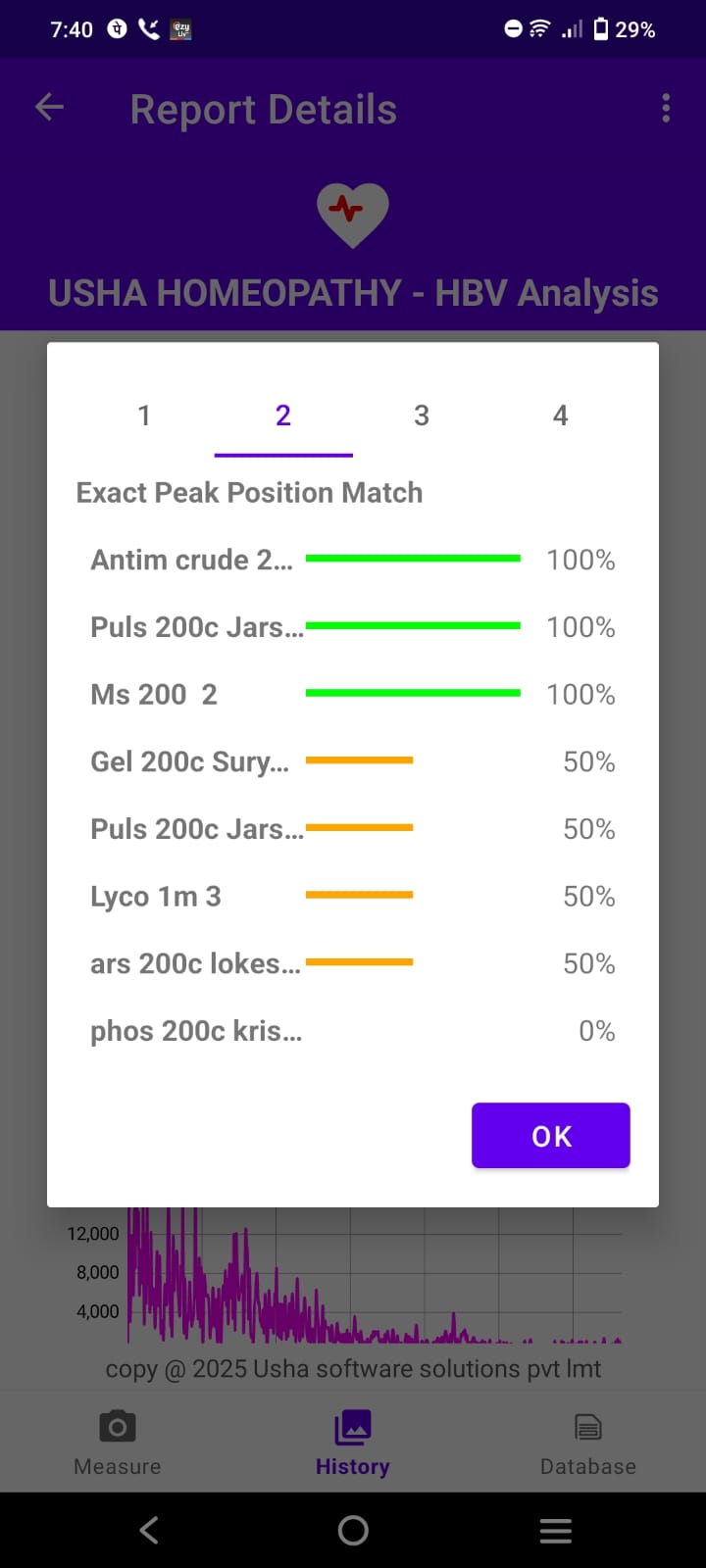
❓ Q2: Doesn’t the mechanical delay (20–40ms after ECG) make HRV unreliable?
✅ Answer: No – the interval between beats remains accurate.
While the mechanical signal occurs after electrical activation, the time between consecutive mechanical beats matches the time between electrical beats with sub-10ms precision.
Think of it this way:
- If two trains arrive 1 minute apart at Station A (electrical), they will arrive 1 minute apart at Station B (mechanical)—even if the journey takes 20 seconds.
- For HRV analysis, consistency of intervals matters more than absolute timing.
Published evidence: Smartphone gyroscopes detect beat-to-beat intervals with ±5.22ms error compared to ECG .
❓ Q3: Can Heart Rate Variability really help select homeopathic remedies?
✅ Answer: Yes – this is published, peer-reviewed research.
The BARC-CCRH Study (2011) – My Research
Study: “An exploratory study on scientific investigations in homeopathy using medical analyzer”
Journal: Journal of Alternative and Complementary Medicine
PMID: 21787219 | DOI: 10.1089/acm.2010.0334
Key Findings:
| Medicine | HRV Response Rate |
|---|---|
| Sulphur (200c, 1M) | 62.5% |
| Gelsemium (200c) | 62.5% |
| Placebo | 16.6% |
Conclusion: “These data suggest that it is possible to record the response of homeopathic medicines on physiologic parameters of the autonomic nervous system.”
This was a collaborative project between:
- Bhabha Atomic Research Centre (BARC) – India’s premier nuclear research facility
- Central Council for Research in Homeopathy (CCRH) – India’s official government homeopathy research body
I served as Senior Research Fellow on this project and am a co-author of this study.
❓ Q4: But doesn’t homeopathic remedy selection require the “totality of symptoms”?
✅ Answer: Absolutely yes – and my app does not replace this.
My application is NOT a diagnostic tool. It does NOT replace:
- Case-taking
- Symptom analysis
- Repertorization
- Classical homeopathic methodology
What it DOES:
- Provides an objective physiological marker to confirm remedy response
- Measures autonomic nervous system changes pre- and post-remedy
- Offers an adjunct to classical practice – exactly as Hahnemann encouraged objective observation
Think of it as:
- A blood pressure monitor for homeopathy
- A way to quantify what was previously only subjective
❓ Q5: Biosignals are affected by many factors – how can they be reliable?
✅ Answer: We use controlled pre-post measurement protocols – the same principle used throughout clinical medicine.
Your concern is valid – absolute HRV values vary between individuals and across conditions.
However, in clinical physiology:
- We don’t measure absolute values in isolation
- We measure relative changes under controlled conditions
Examples from conventional medicine:
| Test | What It Measures |
|---|---|
| Glucose Tolerance Test | Change in blood sugar after glucose load |
| Pulmonary Function Test | Change in breathing before/after bronchodilator |
| Exercise Stress Test | Change in ECG during/after exercise |
| My Method | Change in HRV before/after homeopathic remedy |
The protocol:
- Same person
- Same time of day
- Same posture (lying down)
- Same environment
- Only the remedy changes
The difference tells us whether the autonomic nervous system responded to the medicine.
❓ Q6: Does this replace repertorization?
✅ Answer: No – never.
Let me be absolutely clear:
| My App Does… | My App Does NOT… |
|---|---|
| Measure physiological response | Diagnose disease |
| Track autonomic changes | Replace case-taking |
| Confirm remedy suitability | Replace repertorization |
| Provide objective feedback | Select remedies automatically |
The remedy is always selected based on classical homeopathic principles. The app then helps verify whether the selected remedy produced a measurable physiological response.
❓ Q7: Where can I read the original research?
✅ Answer:
Primary BARC-CCRH Study:
Title: An exploratory study on scientific investigations in homeopathy using medical analyzer
Authors: (including Dr. Devendra Kumar Munta)
Journal: J Altern Complement Med. 2011 Aug;17(8):705-10
PMID: 21787219
DOI: 10.1089/acm.2010.0334
Link: https://pubmed.ncbi.nlm.nih.gov/21787219/
Follow-up Clarification:
Title: Homeopathy and heart rate variability: clarification about concerns and issues
Journal: J Altern Complement Med. 2012 Apr;18(4):428-9
PMID: 22480268
Recent Validation Studies (Smartphone Accuracy):
2025 Study: MDPI Sensors – Smartphone gyroscopes achieve ±5.22ms HRV accuracy vs. ECG
2023 Study: Directory of Open Access Journals – 2.33% mean error for heart rate
❓ Q8: How do you respond to critics who say this is “unscientific”?
✅ Answer: I invite them to read the published evidence.
I am not a hobbyist or someone misinterpreting studies. I was formally employed as a Senior Research Fellow on a government-funded collaborative project between:
- Bhabha Atomic Research Centre (BARC) – India’s premier nuclear research institution
- Central Council for Research in Homeopathy (CCRH) – India’s official homeopathy research body
The research I helped conduct:
- Was peer-reviewed
- Is PubMed-indexed
- Has been cited by other researchers
- Demonstrated statistically significant differences between remedy and placebo
My smartphone application is simply the translation of that government-funded research from expensive laboratory equipment into an accessible tool for practitioners and patients.
❓ Q9: What is the physiological basis for this method?
✅ Answer: Seismocardiography (SCG) and Gyrocardiography (GCG)
| Sensor | What It Measures | Physiological Source |
|---|---|---|
| Accelerometer | Linear vibrations | Heart valve closures (mitral, aortic), blood ejection |
| Gyroscope | Angular rotation | Myocardial “twisting” motion during contraction/relaxation |
| Both | Chest wall movement | Cardiac cycle + respiration |
The gyroscope is particularly sensitive to the heart’s rotational mechanics and consistently outperforms the accelerometer in validation studies.
📊 Summary: Key Facts at a Glance
| Question | Short Answer |
|---|---|
| Is smartphone HRV accurate? | Yes – ±5.22ms vs. ECG (2025 studies) |
| Does mechanical delay matter? | No – intervals remain consistent |
| Can HRV help select remedies? | Yes – proven by BARC-CCRH research |
| Does this replace symptoms? | No – it ADDS objective confirmation |
| Is this published? | Yes – PMID: 21787219 |
| Who conducted the research? | BARC + CCRH – India’s top scientific bodies |
| What was my role? | Senior Research Fellow & Co-author |
🔗 Useful Links
- PubMed Record: https://pubmed.ncbi.nlm.nih.gov/21787219/
- DOI: 10.1089/acm.2010.0334
- My YouTube Channel: http://youtube.com/ushahomeopathytv
- My App: HBV – Biosignal-Homeopathy Remedy Matching
Last Updated: February 2026
Dr. Devendra Kumar Munta
Former Senior Research Fellow, BARC-CCRH Collaborative Project
